
Vietnam is a key player in India's act east policy under Prime Minister Narendra Modi. From India's perspective, a strategic partnership with Vietnam will only deepen political, economic, and security ties and be a bulwark against China, say Melissa S Hersh and Dr Ajey Lele

News of all that's transpired on and off the football field

'This is the first time that the Americans have agreed to refer to "cross-border terrorist attacks" in a joint statement.' 'No wonder Pakistan has called the joint statement "singularly unhelpful" and has blasted it, and its all-weather friend China has applauded Pakistan's frontline role in combating terrorism,' points out former foreign secretary Ambassador Kanwal Sibal.

Fencing the border between Myanmar and Nagaland is expected to adversely affect the Naga tribals. Gautam Sen, an expert on Nagaland, explains why the Indian government needs a more comprehensive and long-term perspective on this issue and why it must take local tribal sensitivities and customs into account.

After helping the government in policymaking since October 2014, Chief Economic Adviser Arvind Subramanian is returning to academics and will be teaching at Harvard Kennedy School on a visiting position. In an interview to Dilasha Seth and Somesh Jha, he says the ease of doing business agenda needs to move forward and India must try to integrate with the global value chains. Edited excerpts.

'Until India fully absorbs the fundamentals of international relations, it will continue to get evil for good,' says Brahma Chellaney.

Dr Manmohan Singh would be faced with very few choices in Beijing given the Chinese conceived notions of the world today and India's low place in their calculus, says Srikanth Kondapalli.
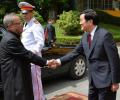
India and Vietnam on Monday inked seven pacts, including one to enhance cooperation in the strategic oil sector, as they called for "freedom" of navigation in the South China Sea, a remark which could irk China, which has been claiming territorial sovereignty over the high seas.


New Delhi and Beijing are the only two regional capitals that have commented on US President Donald Trump's speech on August 21 outlining the way forward in Afghanistan. The Indian foreign ministry statement was effusive in praise, while the Chinese statement has been one of cautious and guarded hope. Delhi has identified itself with Trump's Afghan strategy, whereas the Chinese stance is calibrated -- observant and objective, keeping a distance, says Ambassador M K Bhadrakumar.

The recent withdrawal of subsidies on cooking gas and kerosene to Bhutan, since revived, has raised the hackles in China, with a state-run daily saying India will not allow Bhutan to freely engage with it.

'Nature does not send us a bill, so we ignore them in decision making until we hit a moment of crisis, such as the current shortage of water.'

'The military aim in a future conflict, if it can't be avoided, should be to cause maximum damage to the adversary's war waging capability and capture limited amount of territory as a bargaining counter,' says Brigadier Gurmeet Kanwal (retd).
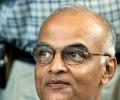
NSA Menon's wisdom says that the idea to be superpower is not really desirable, it is better to be different. Sheela Bhatt reports.

'I want to use my music to reach out to the youth, to inspire them to create history.' 'To share knowledge, to tell them the importance of voting, girl child education, menstrual hygiene.'

In anticipation of a verdict to be delivered by the International Tribunal of the Permanent Court of Arbitration in The Hague on Tuesday, China has orchestrated a worldwide campaign to defuse its findings.
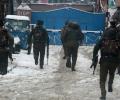
'We need to be in a perpetual state of aggression, and able to swiftly change the goal posts to keep Pakistan in a state of imbalance,' argues Sanjeev Nayyar.

Daring the military-backed government, supporters of deposed Egyptian President Mohammed Morsi have called for a "million person march" tomorrow against his ouster, even as police today arrested two top leaders of an Islamist party in a widening crackdown on protesters.

The President talked about demonetisation, electoral reforms and disruptions in Parliament.

Indians want change and progress. They should be willing to accept tough decisions, says Sanjeev Nayyar.

The Sindhis are a lesson in perseverance. Once uprooted, they've started all over, often reinventing themselves

20 Indian CEOs and 350 companies are participating in the Hannover Fair.
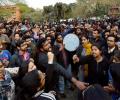
Do the students who chanted pro-separatist slogans and their teachers/supporters want the army to withdraw from Kashmir or not fight the terrorists?

Srikanth Kondapalli on what to expect from the seventh BRICS summit meeting to be held in Russia in July.

Here's the full text of Prime Minister Narendra Modi's address to the United States Congress.

Kailash Satyarthi, co-winner of the Nobel Peace Prize, in front of packed crowd made a rousing speech asking every person to come together and set our children free. He honoured those who came before him and also said that he accepted this honour on behalf of all the martyrs and activists in India. Here's the transcript of his moving acceptance speech.

Stating that India is new bright spot of hope and opportunity for the world, the prime minister said India among other things is igniting the engines of its manufacturing sector and making its farms more productive and more resilient.

'She must first change the Rules of Business 1961 that makes the defence secretary and not the defence minister responsible for the defence of the country!' says Colonel Anil A Athale (retd.)

'Overlying his idealism was a hatred of war and of all things military. He gave no deep thought to politico-military matters and this prevented him from making sound security decisions.'
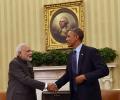
Furthering Indo-US cooperation on terrorism, Prime Minister Narendra Modi and President Barack Obama on Tuesday agreed to make "joint and concerted efforts" to dismantle safe havens for terror and criminal networks like Lashkar-e-Tayib, Jaish-e-Mohammad, Dawood-company, Al Qaeda and the Haqqani network.

Praising the US for turning barriers into bridges of partnership, he said that America had stood with India when the support was needed the most, like when terrorists attacked Mumbai in November 2008 and in other economic endeavours as well

'By beheading an Indian soldier, the Pakistan army has demonstrated its proclivity for barbaric medievalism.' 'The strategies adopted and the punishment inflicted by India must be made progressively more stringent with every new act of terrorism till the cost becomes prohibitive for Pakistan,' says Brigadier Gurmeet Kanwal (retd).

In this May 2014 interview with Vaihayasi Pande Daniel/Rediff.com, the politically conscious Karnad spoke of why he is concerned about Modi coming to power.

The Indian Spring represented by Anna Hazare's anti-corruption campaign, which has culminated in the Aam Aadmi Party's impressive electoral debut in New Delhi, began around the same time as the Arab Spring in 2011 but they led to different outcomes in India and the Arab world, says Ramesh Ramachandran.

On the occasion of Gandhiji's birthday, Rediff.com presents an excerpt from the book that shows how Gandhi changed the face of cricket as it was played then.

'I felt like a used and discarded rag.' 'The pro-dialogue constituency has shrunk in the valley.' Academician and author Dr Radha Kumar was among the three interlocutors which the Manmohan Singh-led UPA government appointed on Kashmir in October 2010, speaks of how the panel report was never acted upon.

The visit of Park Geun-Hye to India, though a symbolic one, will certainly give a further impetus to the strategic partnership between the two countries says Rup Narayan Das.
The ongoing violence in the valley is driving students to excel, but it is also making them angry, discovers Ritwik Sharma.

'President Kalam pitched his dreams high. He will be best remembered for that feat.'
'Both reflect prejudice and short-sightedness peculiar to Mr Modi's way of thinking.'
 © 2026 Rediff.com - Advertise with us - Disclaimer - Privacy Policy - Sitemap - Feedback - About us - Terms of use - Grievances